| SECTION 1: Identification of the substance/mixture and of the company/undertaking |
| NETTOYANT VITRES ECO |
| Aerosol |
| 1.2. Relevant identified uses of the substance or mixture and uses advised against |
| 1.3. Details of the supplier of the safety data sheet |
| CRC Industries Europe BV |
| Touwslagerstraat 1 |
| 9240 Zele |
| Belgium |
| Tel.: +32(0)52/45.60.11 |
| Fax.: +32(0)52/45.00.34 |
| E-mail : hse@crcind.com |
| Subsidiaries | | Tel | Fax |
| CRC Industries Finland Oy | Smedsgatan 3-5 LT4, PL62, 08101 LOJO | +358/(19)32.921 | |
| CRC Industries France | 6, avenue du marais, C.S. 90028, 95102 Argenteuil Cedex | 01.34.11.20.00 | 01.34.11.09.96 |
| CRC Industries Deutschland GmbH | Südring 9, D-76473 Iffezheim | (07229) 303 0 | (07229)30 32 66 |
| CRC INDUSTRIES IBERIA S.L.U. | GREMIO DEL CUERO-PARC.96, POLIGONO INDUSTR. DE HONTORIA, 40195 SEGOVIA | 0034/921.427.546 | 0034/921.436.270 |
| CRC Industries Sweden | Laxfiskevägen 16, 433 38 Partille | 0046/31 706 84 80 | 0046/31 27 39 91 |
| 1.4. Emergency telephone number |
| CRC Industries Europe, Belgium: Tel.: +32(0)52/45.60.11 (office hours: 9-17h pm CET) |
| SECTION 2: Hazards identification |
| 2.1. Classification of the substance or mixture |
| Classification according to Regulation (EC) No 1272/2008 |
| Physical: |
Aerosol, category 3 |
| | Pressurised container: May burst if heated. |
| Classification is based on test data. |
| Health: |
Skin sensitization, category 1 |
| | May cause an allergic skin reaction. |
| Classification based on calculation method. |
| Environment: |
Hazardous to the aquatic environment, chronic category 3 |
| | Harmful to aquatic life with long lasting effects. |
| Classification based on calculation method. |
| Labelling according to Regulation (EC) No 1272/2008 |
| Product identifier: |
Contains: |
| | 2-methyl-2H-isothiazol-3-one |
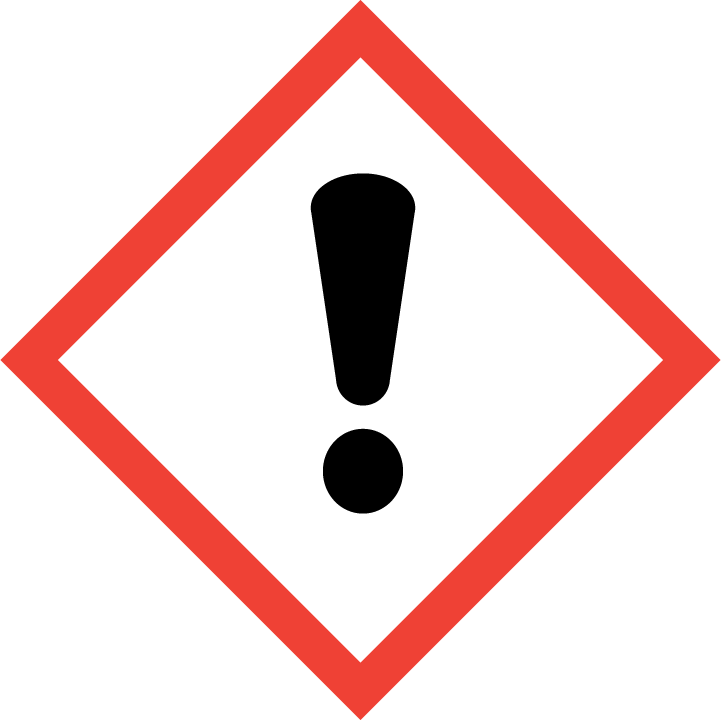
| Hazard pictogram(s): |
 |
|
|
|
| Hazard statement(s): |
H229 : Pressurised container: May burst if heated. |
| | H317 : May cause an allergic skin reaction. |
| | H412 : Harmful to aquatic life with long lasting effects. |
| Precautionary statement(s): |
P102 : Keep out of reach of children. |
|
P210 : Keep away from heat, hot surfaces, sparks, open flames and other ignition sources. No smoking. |
| | P251 : Do not pierce or burn, even after use. |
| | P280-1 : Wear protective gloves/protective clothing. |
|
P333/313 : If skin irritation or rash occurs: Get medical advice/attention. |
|
P410/412 : Protect from sunlight. Do not expose to temperatures exceeding 50°C/122°F. |
|
P501-2 : Dispose of contents/container to an authorised waste collection point. |
| Supplemental Hazard information: |
15 % by mass of the contents are flammable. |
| Regulation (EC) No 648/2004 on detergents: | aliphatic hydrocarbons | 5 - 15 % |
| non-ionic surfactants | < 5 % |
| | benzisothiazolinone, benzoic acid, methylisothiazolinone |
| SECTION 3: Composition/information on ingredients |
| Hazardous ingredient | Registration number | CAS-nr. | EC-nr | w/w % | Hazard Class and Category | Hazard statement | Notes |
| distilled water | - | 7732-18-5 | 231-791-2 | >75 | - | - | G |
| Hydrocarbons,C3-4-rich, petroleum distillate Petroleumgas (1,3-butadiene < 0.1%) | 01-2119485926-20 | 68512-91-4 | 270-990-9 | 5-10 | Press. Gas, Flam. Gas 1 | H280,H220 | K,G |
| pentane | 01-2119459286-30 | 109-66-0 | 203-692-4 | 1-5 | Flam. Liq. 2, Asp. Tox. 1, STOT SE 3, Aquatic Chronic 2 | H225,H304,H336,H411 | A |
| propan-2-ol; isopropyl alcohol; isopropanol | 01-2119457558-25 | 67-63-0 | 200-661-7 | 1-5 | Flam. Liq. 2, Eye Irrit. 2, STOT SE 3 | H225,H319,H336 | B |
| hydrocarbons,C6,isoalkanes,< 5% n-hexane | 01-2119484651-34 | - | (931-254-9) | 1-5 | Flam. Liq. 2, Skin Irrit. 2, STOT SE 3, Asp. Tox. 1, Aquatic Chronic 2 | H225,H315,H336,H304,H411 | Q |
| 3-butoxypropan-2-ol; propylene glycol monobutyl ether | 01-2119475527-28 | 5131-66-8 | 225-878-4 | <1 | Eye Irrit. 2, Skin Irrit. 2 | H319,H315 | |
| 1,2-benzisothiazol-3(2H)-one | - | 2634-33-5 | 220-120-9 | <0.005 | Acute Tox. 2, Acute Tox. 4, Skin Irrit. 2, Eye Dam. 1, Skin Sens. 1, Aquatic Acute 1, Aquatic Chronic 2 | H330,H302,H315,H318,H317,H400,H411 | X,R |
| 2-methyl-2H-isothiazol-3-one | | 2682-20-4 | 220-239-6 | 0.001-0.005 | Acute Tox. 3, Acute Tox. 2, Skin Corr. 1B, Eye Dam. 1, Skin Sens. 1, Aquatic Acute 1, Aquatic Chronic 2 | H301,H330,H314,H318,H317,H400,H411 | M,X |
| Explanation notes |
A : substance with Community workplace exposure limit |
B : substance with national established workplace exposure limit |
G : exempted from the obligation to register in accordance with art.2(7)of REACH Regulation No 1907/2006 |
K : not classified as carcinogen, less than 0.1% w/w 1,3-butadiene (Einecs-nr. 203-450-8) |
M : M acute = 10 |
Q : The CAS-no is only an indicative identifier to be used outside the EU for global inventory entries. |
R : substance in plant protection or biocidal product regarded as being registered (art.15 REACH Regulation No 1907/2006) |
X : SCL (specific concentration limit)in accordance with art.10 of CLP Regulation No 1272/2008 |
| (* Explanation phrases : see chapter 16) |
| SECTION 4: First aid measures |
| 4.1. Description of first aid measures |
| Contact with eyes : |
Avoid contact with eyes. In the event of contact with eyes rinse immediately with plenty of water and seek medical advice. |
| Contact with skin : |
Remove contaminated clothing immediately and drench affected skin with plenty of water. Then wash with soap and water |
| | Seek medical advice |
| Inhalation : |
Remove patient to fresh air |
| Ingestion : |
Seek medical attention if ill effects occur |
| 4.2. Most important symptoms and effects, both acute and delayed |
| Inhalation : |
No harmful effects known if used for its intended purpose |
| Ingestion : |
May cause gastrointestinal disturbances |
| Skin contact : |
May cause sensitisation by skin contact. |
| | Symptoms : redness and pain |
| Eye contact : |
May cause irritation. |
| | Symptoms : redness and pain |
| 4.3. Indication of any immediate medical attention and special treatment needed |
| General Advice : |
If skin irritation or rash occurs: Get medical advice/attention. |
| SECTION 5: Firefighting measures |
| foam, carbon dioxide or dry agent |
| 5.2. Special hazards arising from the substance or mixture |
| Aerosols may explode if heated above 50°C |
| Forms hazardous decomposition products |
| CO,CO2 |
| 5.3. Advice for firefighters |
| Keep container(s) exposed to fire cool, by spraying with water |
| In case of fire, do not breathe fumes |
| SECTION 6: Accidental release measures |
| 6.1. Personal precautions, protective equipment and emergency procedures |
| Shut off all ignition sources |
| Ensure adequate ventilation |
| Wear protective gloves/protective clothing/eye protection/face protection. |
| 6.2. Environmental precautions |
| Do not allow to enter public sewers and watercourses |
| 6.3. Methods and material for containment and cleaning up |
| Absorb spillage in suitable inert material |
| 6.4. Reference to other sections |
| For further information see section 8 |
| SECTION 7: Handling and storage |
| 7.1. Precautions for safe handling |
| Keep away from heat and sources of ignition |
| Do not spray on a naked flame or incandescent material. |
| Do not pierce or burn aerosols, even after use. |
| Do not breathe aerosols or vapours. |
| Ensure adequate ventilation |
| Do not get in eyes, on skin, or on clothing. |
| Wear protective gloves/protective clothing/eye protection/face protection. |
| Contaminated work clothing should not be allowed out of the workplace. |
| 7.2. Conditions for safe storage, including any incompatibilities |
| Pressurized container : protect from sunlight and do not expose to temperatures exceeding 50°C. |
| Keep out of reach of children. |
| SECTION 8: Exposure controls/personal protection |
| Hazardous ingredient | CAS-nr. | method | | |
| EU established exposure limits: |
| pentane | 109-66-0 | TWA | 1000 ppm |
| propan-2-ol; isopropyl alcohol; isopropanol | 67-63-0 | TWA | 400 ppm |
| | STEL | 500 ppm |
| National established exposure limits, United Kingdom |
| pentane | 109-66-0 | TWA | 600 ppm |
| propan-2-ol; isopropyl alcohol; isopropanol | 67-63-0 | TWA | 400 ppm |
| | STEL | 500 ppm |
| National established exposure limits, Ireland |
| pentane | 109-66-0 | TWA | 1000 ppm |
| | STEL | - |
| propan-2-ol; isopropyl alcohol; isopropanol | 67-63-0 | TWA | 200 ppm |
| | STEL | 400 ppm |
| Control procedures : |
Ensure adequate ventilation |
| | Keep away from heat and sources of ignition |
| Personal protection : |
Take precautions to avoid contact with skin and eyes when handling the product. |
| | Ensure adequate ventilation |
| inhalation : |
In case of insufficient ventilation, wear suitable respiratory equipment. |
| hands and skin : |
When handling the product wear chemical-resistant gloves (standard EN 374). |
| | The breakthrough time of the glove should be longer than the total duration of product use. If work lasts longer than the breakthrough time, gloves should be changed part-way through. |
| Recommended gloves: |
Nitrile |
| eyes : |
Wear safety eyewear according to EN 166. |
| Environmental protection: |
Avoid release to the environment. |
| | Collect spillage. |
| SECTION 9: Physical and chemical properties |
| 9.1. Information on basic physical and chemical properties |
| (for aerosols data for the product without propellant) |
| Appearance : physical state : |
Propane/butane propelled liquid. |
| colour : |
Colourless to yellow. |
| Boiling point/range : |
Not available. |
| Flash point : |
42 °C (Closed Cup) |
| Evaporation rate : |
Not available. |
| Explosion limits : upper limit : |
Not available. |
| lower limit : |
Not available. |
| Vapour pressure : |
Not available. |
| Relative density : |
1.0 g/cm3 (@ 20°C). |
| Solubility in water : |
Partly soluble in water |
| Viscosity : |
Not applicable. |
| VOC = volatile organic compounds |
133 g/l |
| SECTION 10: Stability and reactivity |
| No hazardous reactions known if used for its intended purpose |
| 10.3. Possibility of hazardous reactions |
| No hazardous reactions known if used for its intended purpose |
| 10.4. Conditions to avoid |
| 10.5. Incompatible materials |
| 10.6. Hazardous decomposition products |
| SECTION 11: Toxicological information |
| 11.1. Information on toxicological effects |
| acute toxicity: |
based on available data the classification criteria are not met |
| skin corrosion/irritation: |
based on available data the classification criteria are not met |
| serious eye damage/irritation: |
based on available data the classification criteria are not met |
| respiratory or skin sensitisation: |
May cause an allergic skin reaction. |
| germ cell mutagenicity: |
based on available data the classification criteria are not met |
| carcinogenicity: |
based on available data the classification criteria are not met |
| toxicity for reproduction: |
based on available data the classification criteria are not met |
| STOT-single exposure: |
based on available data the classification criteria are not met |
| STOT repeated exposure: |
based on available data the classification criteria are not met |
| aspiration hazard: |
based on available data the classification criteria are not met |
| Information on likely routes of exposure: |
| Inhalation : |
No adverse health effects expected |
| Ingestion : |
May cause gastrointestinal disturbances |
| Skin contact : |
May cause sensitisation by skin contact. |
| Eye contact : |
May cause irritation. |
| Hazardous ingredient | CAS-nr. | method | | |
| pentane | 109-66-0 | LD50 oral rat | > 5000 mg/kg |
| | LD50 derm.rabit | > 3000 mg/kg |
| 3-butoxypropan-2-ol; propylene glycol monobutyl ether | 5131-66-8 | LD50 oral rat | 3300 mg/kg |
| | LC50 inhal.rat | 651 mg/l |
| | LD50 derm.rat | > 2000 mg/kg |
| propan-2-ol; isopropyl alcohol; isopropanol | 67-63-0 | LD50 oral rat | 5840 mg/kg |
| | LC50 inhal.rat | > 25000 mg/l |
| | LD50 derm.rabit | 13900 mg/kg |
| hydrocarbons,C6,isoalkanes,< 5% n-hexane | - | LD50 oral rat | > 5000 mg/kg |
| | LC50 inhal.rat | > 20 mg/l |
| | LD50 derm.rabit | > 3000 mg/kg |
| SECTION 12: Ecological information |
| Hazardous to the aquatic environment, chronic category 3 |
| Harmful to aquatic life with long lasting effects. |
| Hazardous ingredient | CAS-nr. | method | | |
| 3-butoxypropan-2-ol; propylene glycol monobutyl ether | 5131-66-8 | IC50 algae | > 1000 mg/l |
| | LC50 fish | 560-1000 mg/l |
| | EC50 daphnia | > 1000 mg/l |
| propan-2-ol; isopropyl alcohol; isopropanol | 67-63-0 | IC50 algae | 1000 mg/l |
| | LC50 fish | 9640 mg/l |
| | EC50 daphnia | 9714 mg/l |
| hydrocarbons,C6,isoalkanes,< 5% n-hexane | - | IC50 algae | 55 mg/l |
| | LC50 fish | > 1 mg/l |
| | EC50 daphnia | 3.87 mg/l |
| 12.2. Persistence and degradability |
| Readily biodegradable - OECD 301B |
| 12.3. Bioaccumulative potential |
| No experimental data available |
| 12.5. Results of PBT and vPvB assessment |
| 12.6. Endocrine disrupting properties |
| No experimental data available |
| GWP (global warming potential): |
0 |
| SECTION 13: Disposal considerations |
| 13.1. Waste treatment methods |
| National regulations : |
Disposal should be in accordance with local, state or national legislation |
| SECTION 14: Transport information |
| 14.2. UN proper shipping name |
| Proper shipping name: |
AEROSOLS |
| 14.3. Transport hazard class(es) |
| ADR/RID - Classification code: |
5A |
| Packing group: |
Not applicable. |
| 14.5. Environmental hazards |
| ADR/RID - Environmentally hazardous: |
No |
| IMDG - Marine pollutant: |
No |
| IATA/ICAO - Environmentally hazardous: |
No |
| 14.6. Special precautions for user |
| ADR/RID - Tunnelcode: |
(E) |
| 14.7. Maritime transport in bulk according to IMO instruments |
| SECTION 15: Regulatory information |
| 15.1. Safety, health and environmental regulations/legislation specific for the substance or mixture |
| The Safety Data Sheet is compiled according to the current European requirements. |
| Regulation (EC) No 1907/2006 (REACH)
|
| Regulation (EC) No 1272/2008 (CLP)
|
| Dir. 2013/10/EU, 2008/47/EC amendment of the aerosol dispenser directive 75/324/EEC. |
|
| 15.2. Chemical safety assessment |
| SECTION 16: Other information |
| *Explanation hazard statements: |
- : - |
| | H220 : Extremely flammable gas. |
| | H225 : Highly flammable liquid and vapour. |
| | H280 : Contains gas under pressure; may explode if heated. |
| | H301 : Toxic if swallowed. |
| | H302 : Harmful if swallowed. |
| | H304 : May be fatal if swallowed and enters airways. |
| | H314 : Causes severe skin burns and eye damage. |
| | H315 : Causes skin irritation. |
| | H317 : May cause an allergic skin reaction. |
| | H318 : Causes serious eye damage. |
| | H319 : Causes serious eye irritation. |
| | H330 : Fatal if inhaled. |
| | H336 : May cause drowsiness or dizziness. |
| | H400 : Very toxic to aquatic life. |
| | H411 : Toxic to aquatic life with long lasting effects. |
| REVISIONS IN CHAPTRE : |
Classification according to Regulation (EC) No 1272/2008 |
| | Labelling according to Regulation (EC) No 1272/2008 |
| acronyms and synonyms: |
TWA = time weight average |
| | STEL = short time exposure limit |
| | VOC = volatile organic compounds |
| | PBT = persistant bioaccumulative toxic |
| | vPvB = very persitant very bioaccumulative |
This product should be stored, handled and used in accordance with good industrial hygiene practices and in conformity with any legal regulation.
The information contained herewith is based on the present state of our knowledge and is intended to describe our products from the point of view of safety requirements. It does not guarantee any specific properties.
Apart from any fair dealing for purposes of study, research and review of health, safety and environmental risks,no part of these documents may be reproduced by any process without written permission from CRC. |
|